External Research
Four Requests to Shell: Ek0ms's Cacti 0-Day Chain
Ek0ms chained a guest profile setting, stored SQL injection, and the realtime poller into unauthenticated command execution on Cacti 1.2.31 in her lab.
On this page
Four HTTP requests. A guest session. A shell command delivered through a graphing system's own poller.
Ek0ms, publishing with Church of Malware, documented this Cacti chain as 4HTTP2ROOT. A working unauth-RCE against Cacti Core 1.2.31. Her research follows a value from a guest-editable profile setting into a SQL LIMIT clause, then uses the resulting database write to change the command that Cacti's realtime poller executes. The upstream research and PoC are hers; this article summarizes the path and its operating conditions.
The four-request path
| Request | Guest-accessible action | Boundary crossed |
|---|---|---|
| 1 | Open auth_profile.php | Receive a guest session and CSRF token without credentials |
| 2 | POST auth_profile.php?action=update_data | Store a SQL fragment in preview_graphs_per_page |
| 3 | Open graph_view.php?action=preview | Use the stored value in LIMIT; execute a stacked UPDATE against poller_item |
| 4 | Open graph_realtime.php?action=init | Run the altered poller command through popen() |
The first request is ordinary guest behavior. The failure is that a guest can write a value later treated as trusted SQL syntax.
1. A guest session can edit a numeric setting
With the guest account enabled, a fresh visitor can open the profile page and obtain a session cookie plus csrfMagicToken. No account credentials are needed. Ek0ms used that token to submit name=preview_graphs_per_page and an arbitrary value to the profile update action.
That setting is meant to hold a graph count. The profile write uses a prepared statement, but it does not enforce an integer value. The database faithfully stores the attacker's string; the vulnerability appears when another code path reads it back.
GET  /cacti/auth_profile.php?tab=general&header=false
POST /cacti/auth_profile.php?tab=general&action=update_data&header=false

name=preview_graphs_per_page
value=1;UPDATE poller_item SET host_id=1,action=1,arg1=0x... WHERE local_data_id=1;--
The row identifiers above are from the lab, not universal Cacti constants. The hex value represents the command placed in arg1.
2. A stored page size becomes SQL
The preview action loads preview_graphs_per_page as the default graphs value. The request-side integer filter does not cover that database-sourced default. The value is then concatenated into a LIMIT fragment passed to get_allowed_graphs().
GET /cacti/graph_view.php?action=preview&page=1&clear=1

... LIMIT 0,1;UPDATE poller_item SET ...;--
Ek0ms reports that the PDO path in her test accepted the stacked statement. The appended UPDATE changed poller_item.arg1, while the HTTP response still rendered a preview page. Her writeup notes a PHP warning about a nonnumeric value, but no obvious failure in the browser response.
This is the decisive trust mistake: validation on an incoming request does not make a stored default safe. The value needs to be constrained before storage and before it enters SQL.
3. The realtime poller turns the write into execution
The same guest session can initialize a realtime graph. That request reaches poller_realtime.php, then cmd_realtime.php, where the poller reads the modified arg1 and calls exec_poll(). The latter opens the command with popen().
GET /cacti/graph_realtime.php?action=init&local_graph_id=1&ds_step=10&size=90

cmd_realtime.php:  exec_poll($item['arg1'])
lib/poller.php:     popen($command, 'r')
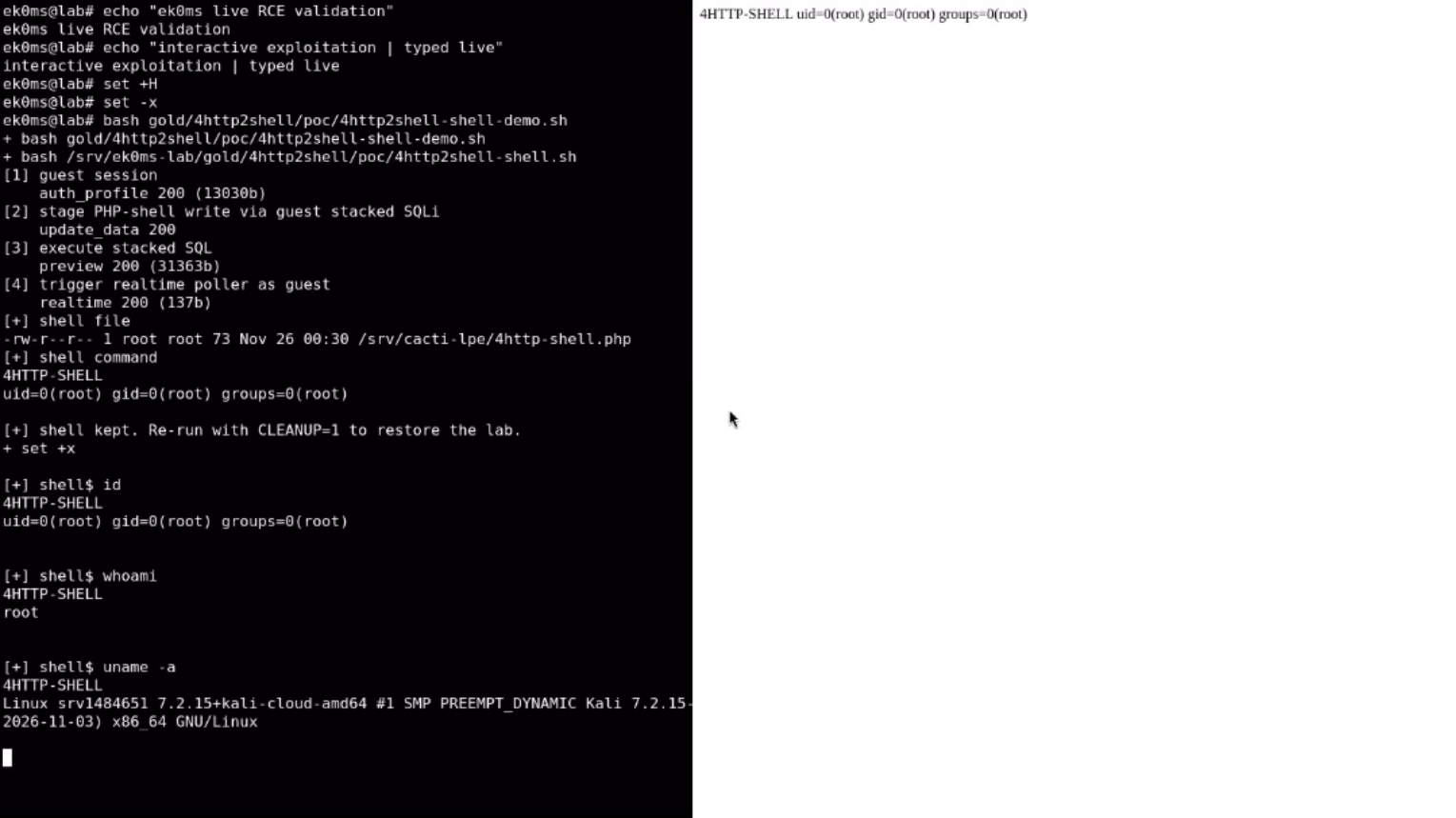
The graph ID and poller item must be valid for the target. Ek0ms's upstream shell demo uses the four-request route to stage a PHP shell, then validates it with commands such as id and whoami. The supplied lab screenshot records successful guest requests and a root shell in that configuration.
Why the chain works
Four separate behaviors make the path possible:
- Guest profile updates accept an arbitrary string for a setting that should be numeric.
- The stored default bypasses request validation when the graph preview reads it.
- The SQL query concatenates that value into
LIMIT, and the tested database path executes the appended statement. - The poller executes a database-stored command that the injected
UPDATEcan replace.
The observable trail is correspondingly mundane: a guest profile update, a graph preview, and a realtime graph initialization. The malformed page-size value, a nonnumeric PHP warning, a change to poller_item.arg1, and any newly written shell or marker are stronger investigation pivots than the HTTP status codes alone.
What to fix
Treat these as separate boundaries. Validate preview_graphs_per_page as an integer on write and on read. Bind numeric pagination values instead of concatenating them into SQL; reject stacked statements where the database driver permits configuration. Restrict guest profile writes to settings the guest actually needs. Keep poller command inputs under explicit authorization and detect unexpected changes to poller_item, especially arg1.
Ek0ms validated the chain against her Cacti 1.2.31 lab. The supplied research does not establish whether other versions, guest configurations, or database settings are exploitable. Consult her original 4HTTP2ROOT writeup and PoC for source, reproduction details, and updates.